
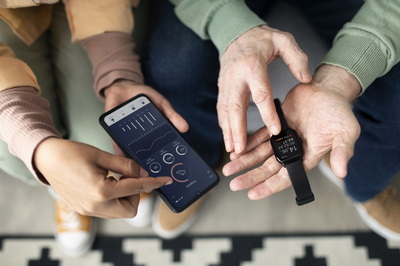
In the modern world, wearable technology has evolved far beyond fitness tracking or timekeeping. Today’s smartwatches and health bands are becoming powerful partners in healthcare — capable of continuously monitoring vital signs, detecting abnormalities, and even preventing diseases.
What makes this technology truly revolutionary is its role in telemedicine — the delivery of medical services remotely through digital platforms.
Imagine being able to track your heart rate, blood pressure, oxygen level, sleep pattern, and activity — and automatically share that data with your doctor in real time.
Telemedicine allows doctors to evaluate, diagnose, and manage patients remotely using communication technology. In recent years, wearable devices have become an integral part of this digital health ecosystem.
From Apple Watch and Samsung Galaxy Watch to Fitbit and Xiaomi smart bands, these devices are equipped with advanced biosensors capable of measuring various physiological parameters.
Modern smartwatches are miniature health labs on your wrist. They continuously record and analyze a wide range of biological signals, including:
Heart Rate (HR): Detects arrhythmias and irregular heartbeats
Blood Pressure (BP): Monitors cardiovascular health
Blood Oxygen Saturation (SpO₂): Evaluates respiratory function
Sleep Quality: Detects sleep disorders like insomnia or apnea
Activity and Steps: Tracks daily movement and calorie burn
Body Temperature and Stress: Detects fever, anxiety, or fatigue
Perhaps the greatest value of wearable technology lies in proactive healthcare — detecting problems before they become serious.
Smartwatches like Apple Watch or Samsung Galaxy Watch can detect atrial fibrillation (AFib) and notify users when an irregular heartbeat is detected.
During and after the COVID-19 pandemic, oxygen monitoring became vital.
Smartwatches capable of tracking SpO₂ levels can alert users — and their doctors — when oxygen saturation drops, enabling early intervention.
Some advanced wearables analyze temperature, pulse, and other signals to estimate blood sugar fluctuations.
Soon, Telepezeshk aims to integrate such features into its system, empowering diabetic patients to share real-time glucose insights with their doctors.
Continuous monitoring reveals subtle physiological changes that may indicate illness long before symptoms appear — allowing timely medical intervention.
Instead of relying on periodic check-ups, doctors can access live health data for more precise treatment adjustments.
Seeing real-time health stats motivates patients to stay active, eat better, and follow medical recommendations more faithfully.
Patients only need to visit a clinic if significant changes are detected — saving time, money, and reducing healthcare system burden.
Combining wearable data with expert medical analysis through Tele Pezeshk creates a personalized, data-driven health record for each patient.
Despite the advantages, several challenges must be addressed for successful implementation:
Data Accuracy: Some consumer-grade devices may not provide medical-grade precision.
Privacy and Security: Patient health data must be securely encrypted and protected.
Cost: Advanced smartwatches are still relatively expensive for some users.
Lack of Awareness: Many patients are unaware of the full medical potential of their devices.
The future looks incredibly promising.
Wearables are becoming smarter and more integrated with AI and big data analytics, enabling highly accurate medical predictions.
In the near future, smartwatches will be able to:
Measure blood glucose non-invasively (without needles)
Analyze brainwave patterns to detect stress or depression
Send emergency alerts directly to doctors in real time
Telepezeshk is already developing integrations that will allow wearable data to automatically sync with each patient’s electronic medical record (EMR) — creating a truly connected healthcare ecosystem.
Smart wearables are no longer just health accessories — they are becoming digital extensions of doctors’ eyes and ears.
The combination of wearable technology and platforms like Telepezeshk transforms healthcare from occasional visits to continuous, intelligent care.
Patients gain peace of mind through 24/7 monitoring, and doctors can make faster, data-driven decisions.